


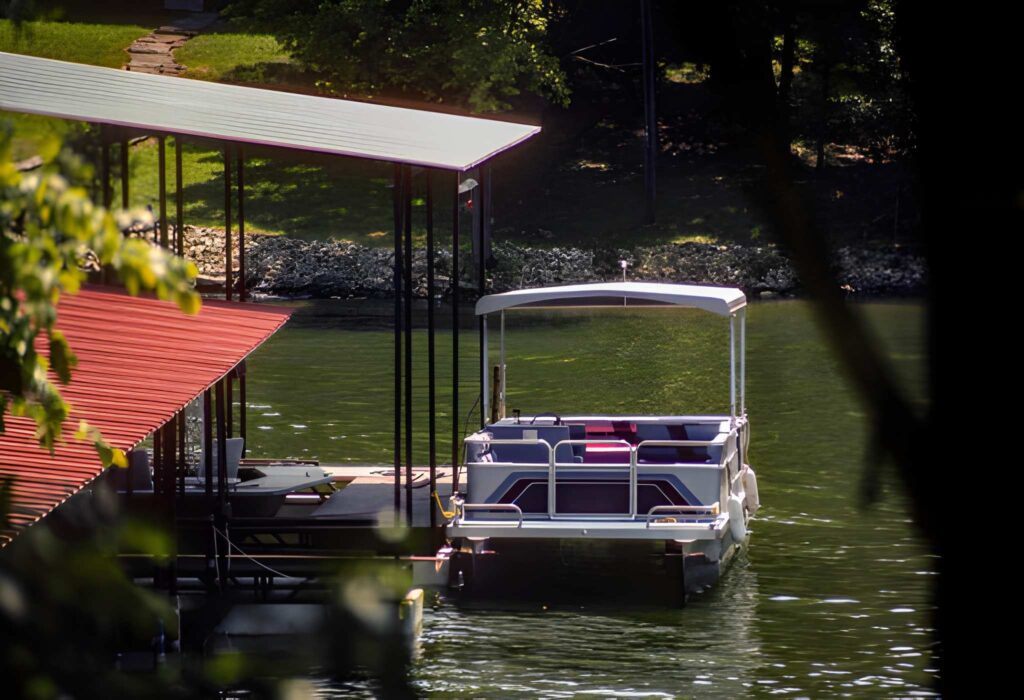
Pontoon boats are built very differently from traditional V-hull boats, and that difference has a big impact on weight. Their wide beam, multiple pontoons, and solid decking often raise an important question for owners and buyers alike: how much does a pontoon boat really weigh, and can it be towed safely?
This Pontoon Boat Weight guide breaks down real numbers from 9 pontoon boat examples, explains what those weights mean for trailering, and shares practical towing tips to help avoid common and costly mistakes.
Typical Pontoon Boat Weights
Pontoon boats vary in weight depending on their length, engine size, and onboard features. On average, a pontoon boat weighs about 120 pounds per foot. For example, a 25-foot pontoon usually comes in around 3,000 pounds dry, before fuel, gear, and passengers are added.
Engines and full fuel tanks can add hundreds of extra pounds, so the total weight when ready to go is often significantly higher. Knowing the exact weight is essential for safe towing and proper load distribution.
Now, let’s explore 9 real pontoon boat examples and see how their weights compare.
9 Real-World Pontoon Boat Weight Examples
Pontoon boats come in a wide range of sizes, layouts, and engine options, which means their weights can differ significantly. Larger engines, extra seating, and added features all contribute to the total weight, making it important to understand what each boat actually weighs.
To give a clear picture, here are 9 real pontoon boat examples with their dry weights, capacities, and towing considerations. This helps owners and buyers see how weight varies across popular models.
1) Lowe Retreat 230 RFL
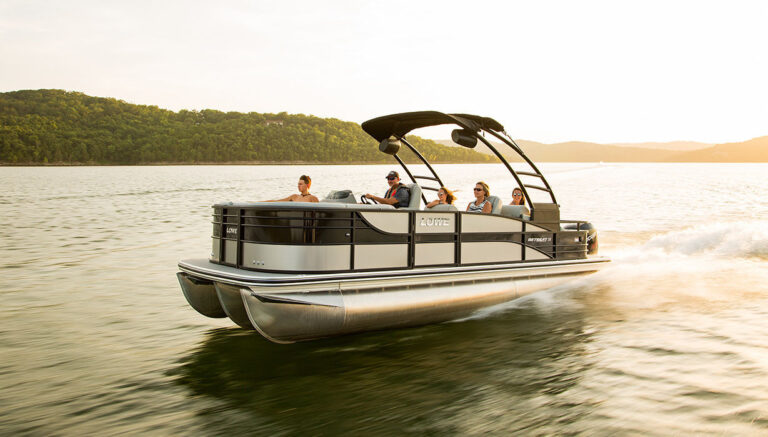
The Lowe Retreat 230 RFL is one of the brand’s more compact pontoon boats, making it a great choice for smaller waterways or easier trailering. It measures approximately 23’7” long with a beam of 8’6”. The deck spans 23 feet, while the pontoons themselves are 22’3” long and 25 inches in diameter.
Engine options range from 150 to 250 horsepower, paired with fuel tanks between 24 and 50 gallons, depending on the model. The hull’s dry weight sits between 2,600 and 3,000 pounds, translating to roughly 108-125 pounds per foot.
Seating accommodates around 8 people comfortably, but the boat can hold up to 11 passengers with light gear. Maximum weight capacities range from 2,100 to 2,700 pounds, including passengers and personal items.
Additional features adding to the total weight include:
- Two reclining chairs;
- Driver and passenger seats;
- Lounge seating;
- 9-foot bimini top;
- Large marine stereo system.
Towing tip
This model can often be towed by a small SUV or minivan, provided it has a proper towing package.
2) Lowe Retreat 250 RFL
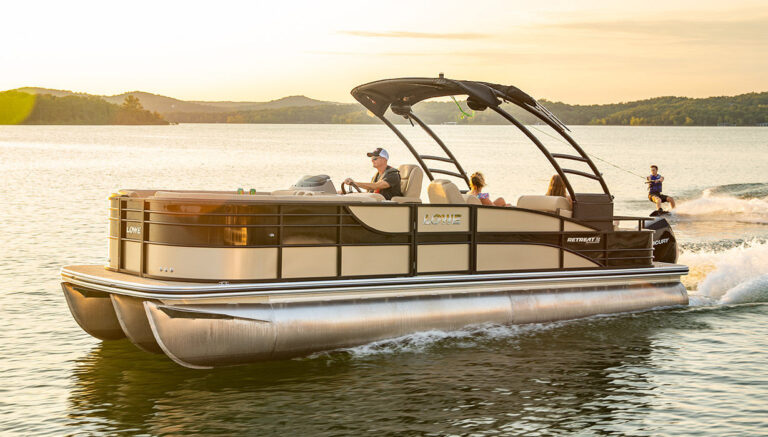
The Lowe Retreat 250 RFL is a slightly larger model in the Retreat lineup, offering extra deck space and seating while maintaining smooth handling on the water. The boat measures about 25’7” in overall length, with a 25-foot deck and 24’3” pontoons, each 25 inches in diameter. The beam stretches 8’6”, giving a stable ride even in light chop.
Engine options range from 150 to 300 horsepower, fueled by 24, 30, or 50-gallon tanks depending on the configuration. Dry hull weight varies from 2,700 to 3,300 pounds, which comes out to roughly 103-126 pounds per foot.
The Retreat 250 RFL can accommodate 12 to 14 passengers, with maximum weight capacities of 2,300 to 2,600 pounds. The deck layout is designed for comfort and socializing:
- Rear reclining chairs for relaxation;
- Driver and passenger seats behind a protective glass windshield;
- Bow seating at the front, providing extra passenger space.
Additional features include a marine-grade stereo, plush seating, swivel recliners, a heavy-duty boarding ladder, and a 9-foot bimini top for sun protection.
Towing tip
Due to its size and weight, this pontoon is best towed by a large SUV or a small truck equipped with the proper towing package.
3) Lowe Retreat 270 Extended WT
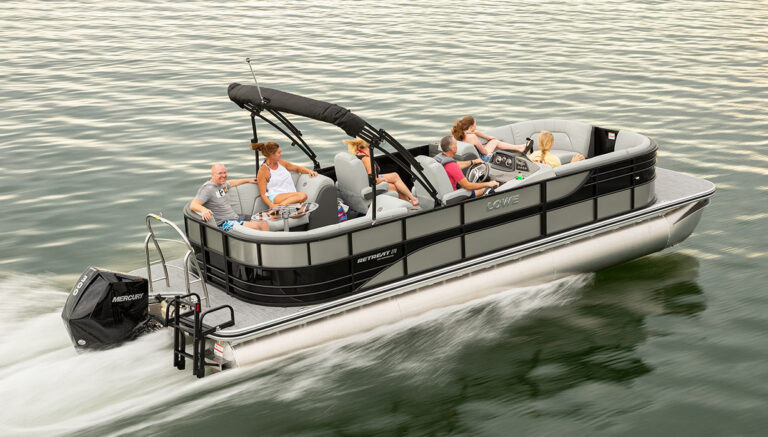
The Lowe Retreat 270 Extended WT is one of the larger models in the Retreat series, designed for families and groups who need extra space and comfort. It measures 27’11” overall, with a 27-foot deck and 26’3” pontoons, each 25 inches in diameter.
The dry weight of this pontoon is approximately 3,500 pounds, with a maximum weight capacity of 2,763 pounds. This configuration assumes a 300 HP engine, which is the largest size recommended for this model. The boat can safely hold up to 14 passengers.
The deck layout prioritizes both relaxation and socializing:
- Two rear recliners that can convert into semi-circle seating;
- Front semi-circle seating with a doorway to the bow;
- Captain’s chair and passenger seat in the center, with an opening windshield for easy access to the front deck;
- Stereo system and 9-foot bimini top for comfort and sun protection.
This model is noticeably heavier than smaller pontoons, mostly due to the larger engine and extra furniture.
Towing tip
Given its size and weight, the Retreat 270 Extended WT is best transported with a truck or large SUV to ensure safety and stability on the road.
4) Sun Tracker Party Barge 18 DLX
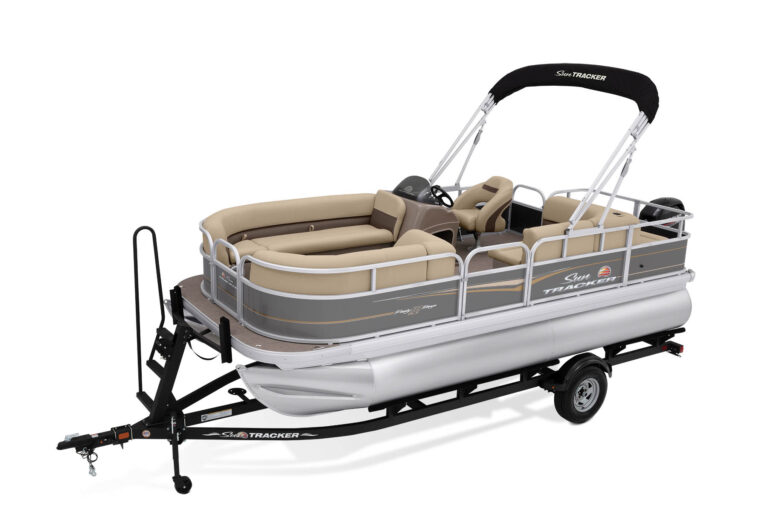
The Sun Tracker Party Barge 18 DLX is a compact and versatile pontoon, ideal for small groups or beginners who want an easy-to-tow boat. It measures 20 feet long with a 17’8” deck and a width of 8’2”. The pontoons are 18’4” long with a diameter of 24 inches.
This model does not include a motor, but a 75 HP engine is recommended. The dry weight without the engine is around 1,495 pounds, while the typical package with motor and seating reaches roughly 3,008 pounds. A full 32-gallon fuel tank adds several hundred pounds on top of this.
The Party Barge 18 DLX can comfortably hold up to 9 passengers, totaling about 1,220 pounds of people and gear. The layout includes:
- Bench seating at the front and one side of the rear;
- Driver’s seat with a small steering console;
- Multiple doorways (front, back, and side);
- Rear boarding ladder for easy water access.
Towing tip
Thanks to its lighter weight, this pontoon can often be towed with a mid-size SUV or minivan equipped with a proper towing package.
5) Sun Tracker Party Barge 22 DLX
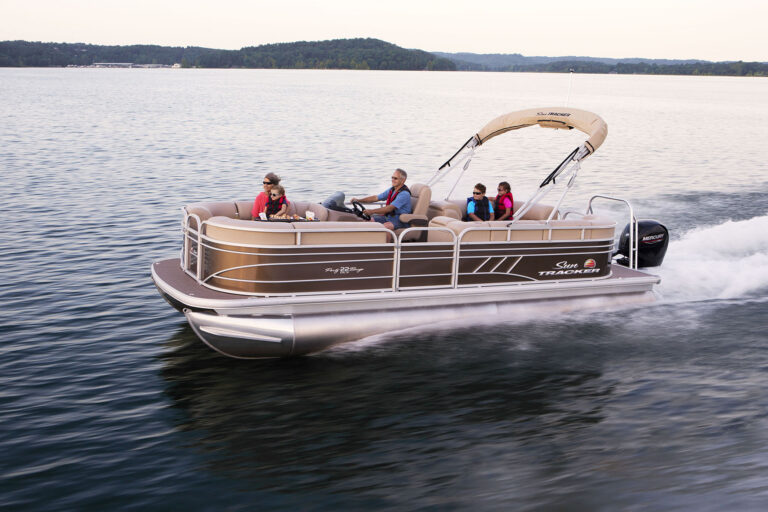
The Sun Tracker Party Barge 22 DLX is a spacious pontoon designed for larger groups and recreational outings. Its overall length is 24’2”, with a 22’1” deck and a beam of 8’6”. The pontoons measure 22’3” in length and 24 inches in diameter, providing excellent stability on the water.
The dry weight of this model is around 1,920 pounds, but a fully equipped package, including a 150 HP engine and a 32.1-gallon fuel tank, brings it to approximately 3,754 pounds.
The deck layout is functional and social:
- Rear bench seating on both sides, with a back door leading to a ladder
- Central driver’s console with additional entryway
- Front bench seating on either side, with a center entry door
- Included bimini top, marine stereo, and pop-up changing stations
This pontoon can carry up to 11 passengers, with a combined maximum weight of 1,500 pounds. Note that fully loading with 11 adults may exceed the recommended limits.
Towing tip
Due to its size and weight, this boat requires a large SUV or truck. Smaller trucks may need weight distribution hitches and sway control bars to tow safely.
6) Sun Tracker Party Barge 24 DLX
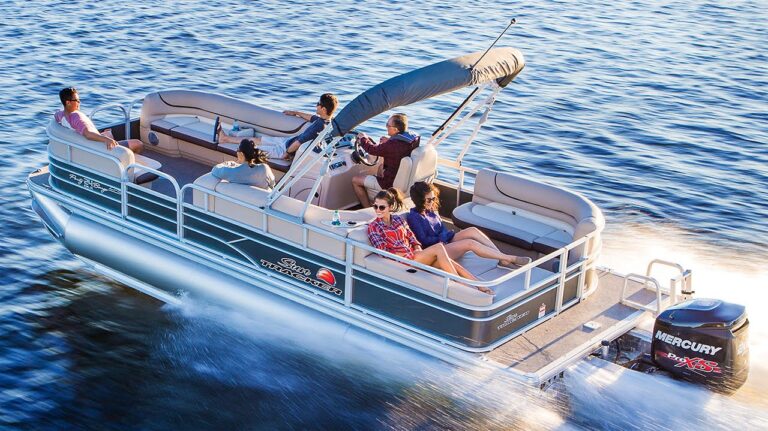
The Sun Tracker Party Barge 24 DLX is one of the largest models in the Sun Tracker lineup, designed for groups who want maximum space and comfort. It measures 26’2” overall, with a 24’1” deck and a beam of 8’6”. The pontoons are 23’7” long and 24 inches in diameter, providing excellent stability even with a full load.
The dry weight of this model is around 2,200 pounds, while the fully equipped package, including a 150 HP motor, front and rear bench seating, captain’s chairs in the center, and a rear boarding ladder, brings the total to approximately 4,361 pounds. Entry doors at the front, back, and side make boarding easy.
This pontoon can accommodate up to 12 passengers, with a maximum combined weight of 1,685 pounds. When adding gear and a 32.1-gallon fuel tank, total weight for people and gear can reach 2,350 pounds.
Towing tip
Due to its size and weight, this model requires a truck capable of towing around 5,000 pounds. Most smaller trucks with engines larger than 4 cylinders may manage, but typical SUVs generally cannot tow this safely. Larger SUVs, such as Chevy Tahoes or Suburbans, can handle it without issues.
7) Starcraft CX 21 C
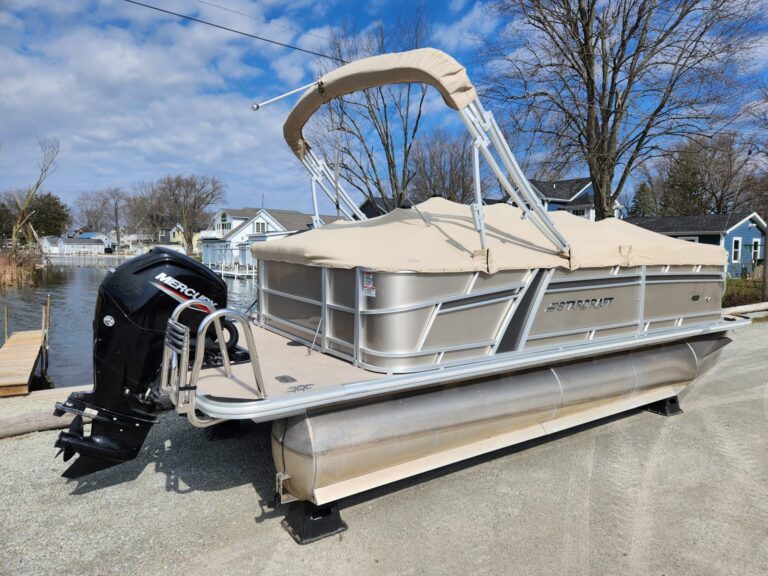
The Starcraft CX 21 C is a compact and efficient pontoon, perfect for families or small groups looking for a lightweight option. It measures 20’10” in length with a beam of 102 inches, and its pontoons are 25 inches in diameter.
Without an engine, the dry weight is approximately 1,850 pounds, including front bench seating and a small L-shaped dinette at the rear. The deck is built from ¾-inch marine-grade plywood and covered with UV-resistant marine carpeting, while additional features include a boarding ladder and a bimini top.
A 20-gallon built-in fuel tank supports the recommended 125 HP engine, mounted on a 20-inch center transom at the stern. Once the engine, fuel, and personal gear are added, towing requirements increase, and a larger SUV or truck is recommended. For lighter setups with a smaller engine, some mid-size SUVs may be able to tow safely.
Towing tip
Always match towing capacity to total boat weight, including fuel, gear, and passengers, to ensure safe transport.
8) Starcraft EXS 3
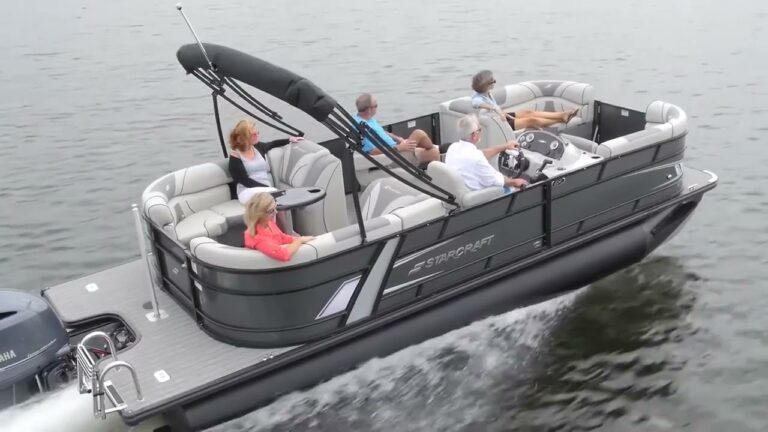
The Starcraft EXS 3 is a 23’10” pontoon with a 102-inch beam, designed for comfort and versatility on the water. Its pontoons are 25 inches in diameter, and the deck is made from ¾-inch marine-grade plywood, finished with durable marine carpeting. Standard features include a marine stereo system and a bimini top for shade.
This model supports engines up to 250 HP, powered by a 60-gallon fuel tank. While a larger engine adds performance, it also significantly increases the boat’s overall weight.
Despite the added weight, the EXS 3 is rated for up to 11 passengers with a maximum combined weight of 1,500 pounds. Optional add-ons like grills, portable toilets, and pop-up privacy tents will further increase weight, reducing the carrying capacity.
The dry weight of the boat, without the engine or fuel is over 2,100 pounds. Because of this, a proper tow vehicle, such as a large SUV or truck, is necessary to transport the boat safely.
Towing tip
Always consider additional gear and fuel when calculating total towing weight to ensure safe and legal transport.
9) Starcraft SLS 5
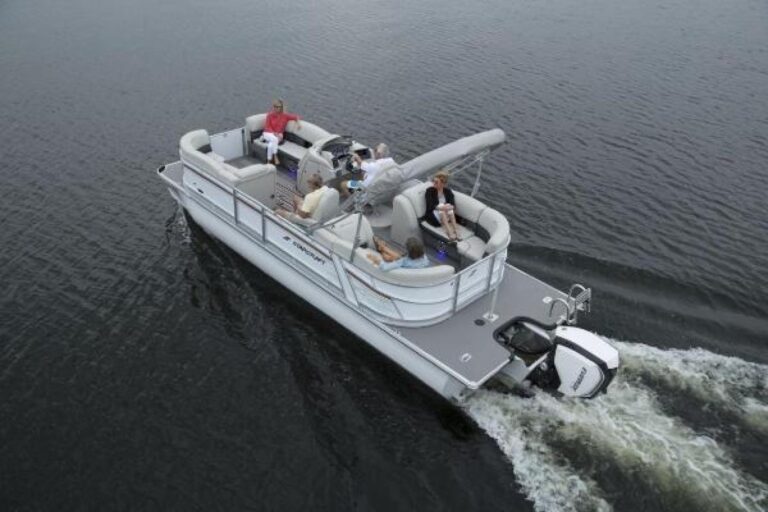
The Starcraft SLS 5 is a large and powerful pontoon, measuring 25’10” in length with a 102-inch beam. The pontoons are 25 inches in diameter, and the deck is built from ¾-inch marine-grade plywood, providing a solid and durable foundation.
The dry weight is nearly 3,000 pounds, and it can accommodate engines up to 300 HP. Fuel options include a 40-gallon tank or an optional 60-gallon tank, which adds significant weight.
This spacious pontoon can carry up to 14 passengers, with a total weight capacity of 2,590 pounds. Comfort is a priority, with lounge seating in both the front and rear of the boat, making it ideal for social outings.
Standard features include a boarding ladder and a bimini top, and an optional kit table can be added to enhance the lounging area.
Towing tip
Due to its size and weight, even a small truck or large SUV may struggle. For safe and reliable towing, a full-size truck is recommended.
Towing a Pontoon Boat
Even smaller pontoon boats can be tricky to tow due to their wide beams, which increase wind resistance and put extra strain on a vehicle’s engine and transmission.
Most pontoon trailers require trailer brakes, meaning the tow vehicle must have a brake controller. Smaller vehicles may also need weight-distribution hitches and stabilizer bars to maintain safe handling on the road.
The average pontoon ranges from 20 to 26 feet long and often carries engines between 150 HP and 250 HP, resulting in total towing weights over 3,000 pounds once fuel, passengers, and gear are included. Many vehicles are not rated to tow this safely, and using an undersized vehicle can be both illegal and dangerous.
For owners who only move their boat occasionally, hiring a professional towing service a few times per year can save money, reduce wear on your vehicle, and simplify logistics.
For regular trailering, a full-size truck is the safest choice. Its height and width help offset wind drag, and it can handle the combined weight of the pontoon and trailer. When preparing a truck for towing, consider suspension upgrades, airbags, and a transmission cooler. Installing these before towing is critical, adding them after damage has occurred won’t solve existing issues.
Pro tip
Always match your tow vehicle’s capacity to the total loaded weight of the boat, including fuel, gear, and passengers, to ensure safe and legal towing.
Pontoon Boat Construction: Key Details for Weight and Performance
Modern pontoon boats are built with two or three aluminum pontoons connected by aluminum cross members, which are both welded and bolted for strength. This framework provides stability and supports the flat deck above.
The deck is typically made from ¾-inch marine-grade plywood, which is carefully waterproofed using fiberglass or specialized sealants before installation. Most decks are then covered with marine carpeting, designed to resist mold, mildew, and UV damage.
Decks usually feature aluminum rails and matching doors, and most pontoons come equipped with a bimini top for shade and comfort.
Engines are commonly outboard motors mounted on an aluminum transom. Single engines are usually center-mounted, while dual-engine setups may be positioned at the ends of the pontoons.
While aluminum and marine plywood are relatively light on their own, the combined weight of multiple pontoons, decking, seating, and engines can make pontoon boats heavier than standard aluminum boats.
Trailers add additional weight as well, though most are constructed from aluminum to minimize the impact. Properly understanding the construction and materials is essential for safe towing, optimal performance, and making informed decisions about upgrades or modifications.
Pro tip
Knowing the boat’s construction helps predict dry weight vs. fully loaded weight, which is critical for towing safety and planning for fuel, gear, and passenger capacity.
Frequently Asked Questions (FAQ)
A pontoon boat usually weighs around 120 pounds per foot. A 25-foot model has a dry weight of about 3,000 pounds, excluding fuel, passengers, and gear.
Dry weight is the boat’s weight without fuel, passengers, or equipment. Fully loaded weight includes the engine, fuel, passengers, and all gear, which can add hundreds or even over a thousand pounds.
Engines, especially larger ones from 150 to 300 HP, can significantly increase a pontoon boat’s total weight. This is important to consider when towing.
Fuel can add 150 pounds for smaller tanks and up to 400 pounds or more for large 60-gallon tanks, impacting towing and load distribution.
Smaller pontoon boats can be towed by mid-size SUVs or minivans with proper towing packages, while larger models require full-size trucks or large SUVs to handle the weight safely.
Their wide beam increases wind resistance, putting extra strain on the tow vehicle. Proper trailer brakes, hitches, and stabilizers are often needed for safe towing.
Yes, choosing a smaller engine, removing non-essential accessories, and using a lightweight aluminum trailer can help lower total weight.
Final Thoughts on Pontoon Boat Weight
Understanding the weight of a pontoon boat is essential for safe operation, towing, and performance. Both the dry weight, the boat without fuel, passengers, or gear and the fully loaded weight with engine, fuel, and accessories must be considered. A full fuel tank alone can add hundreds of pounds, especially on larger pontoons with tanks of up to 60 gallons.
Knowing the dry weight is also helpful if planning future upgrades, such as installing a bigger engine or adding additional gear. Proper weight management ensures the boat remains stable, safe, and enjoyable for all passengers while staying within towing limits.
Pro tip
Always calculate the total weight, including passengers, gear, and fuel, before towing or modifying your pontoon boat to avoid exceeding safe limits.