

Anchoring a pontoon boat looks easy, until the wind picks up or boat traffic starts pushing you around. Many new pontoon owners assume any heavy object will do the job. Unfortunately, pontoons catch wind easily, ride high on the water, and need proper anchoring to stay put.
In this guide, we’ll break down the three anchor types that actually work for pontoon boats, explain when to use each one, and cover some critical safety tips every pontoon owner should know.
The 3 Anchor Types That Work Best for Pontoon Boats
There’s no single anchor that works perfectly everywhere. Bottom type, wind, water depth, and current all play a role. That said, most pontoon owners can cover nearly all conditions with one (or sometimes two) of the anchor styles below.
1. Fluke Anchors (Best for Sand and Gravel)

- The Fortress Anchor Advantage: A hardened High-Tech, rustproof aluminum-magnesium alloy anchor.
- For boats of 33-38’ feet, Fortress FX-16 Anchor has superior holding power at a fraction of the weight...
- Highest rating in over 20 independent tests worldwide. Over 1 million+ people have joined the Fortress Marine...
- FORTRESS ANCHORS: offers a 100% Hassle-Free Lifetime Warranty, and a product made in the USA.
- FORTRESS ANCHORS: provides a product tested and used by the U.S Navy and U.S Coast Guard.
Best bottom type: Sand, firm mud, gravel
Why it works: Digging flukes provide strong holding power
Fluke anchors are one of the most popular choices for pontoon boats, and for good reason. Instead of relying on sheer weight, they use wide flukes that dig into the bottom, creating excellent holding power without needing to be overly heavy.
In calm conditions, a properly sized fluke anchor can hold even a large 28-30 ft pontoon. In moderate wind or chop, they still perform well as long as the anchor sets correctly.
What to know before buying
- Size matters more than weight, larger flukes = better grip;
- Heavier anchors help the flukes dig in, especially in sand;
- Softer mud often requires less weight than sand.
Premium fluke anchors tend to outperform cheaper models, especially when conditions get rough.
2. Box Anchors (Ideal for Mud and Light Vegetation)

- The ORIGINAL Box Anchor by Slide Anchor/ Large Box Anchor 25lbs/ Hot Dip Galvanized/Boats to 35ft/ Storage bag...
Best bottom type: Mud, silt, weedy lakes and slow rivers
Why it works: Large surface area grips soft bottoms
If most of your boating happens on inland lakes or rivers with muddy bottoms, a box anchor is hard to beat. These anchors create resistance by maximizing contact with the bottom rather than digging deeply.
Box anchors are especially popular with pontoon owners because they:
- Hold well in changing wind directions;
- Don’t rely on sharp flukes;
- Set consistently in soft bottoms.
Critical tip
Scope is everything. You’ll want at least a 5:1 ratio of rope length to water depth.
Example: 20 ft of water = 100 ft of anchor line.
Without enough line, the anchor won’t sit at the correct angle, and even the best box anchor will drag.
If you had to pick only one anchor type, this would cover the majority of conditions.
3. Grapnel Anchors (Best for Rocky Bottoms)

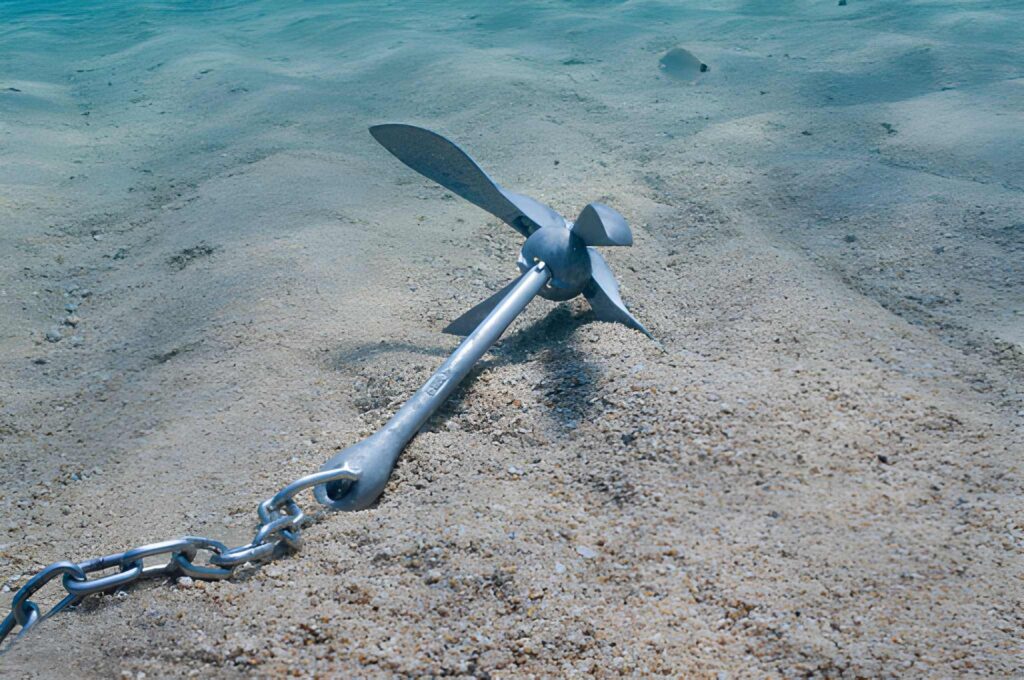
- Dependable anchor can be folded up to reduce its size for easy storage when not in use
- Versatile anchor can be locked in either the open or closed position
- Rugged anchor is made of malleable iron
- Heavily galvanized for long-term corrosion-resistant performance
- Ideal for use by small watercraft and dinghies

Best bottom type: Rock, boulders, uneven hard bottoms
Why it works: Multiple arms hook into solid structure
Rocky bottoms are tricky. Anchors designed for sand or mud often struggle here. That’s where grapnel anchors shine.
These anchors use multiple folding arms that hook onto rocks or crevices. They may drift slightly before setting, but once they grab, the hold is extremely solid.
Why pontoon owners like grapnel anchors
- Compact and easy to store;
- Affordable compared to other anchor types;
- Excellent holding power on rocky terrain.
Many boaters keep a grapnel anchor as a secondary anchor specifically for rocky areas.
Why Proper Anchoring Matters (And What Can Go Wrong)
Anchoring isn’t dangerous by default, but mistakes can be deadly.
Over the years, multiple fatal boating accidents in the U.S. have been linked to improper anchoring. Common factors include:
- Anchor lines wrapping around legs or hands;
- Anchoring from the stern instead of the bow;
- Too little anchor line deployed;
- Trying to power a stuck anchor loose.
In several real-world cases, boats flipped after anchors caught suddenly or were tied improperly, throwing passengers into cold water where hypothermia became fatal.
Key Anchoring Safety Rules
- Always anchor from the bow, never the stern;
- Keep hands, feet, and loose clothing clear of the anchor line;
- Never try to free a stuck anchor by gunning the engine;
- Use enough line to maintain a safe anchor angle;
- Wear life jackets when anchoring in deep or cold water.
Anchoring safely isn’t complicated, but it does require attention and patience.
Frequently Asked Questions About Pontoon Boat Anchors
Most 20-24 ft pontoon boats use anchors between 15-25 lbs, depending on anchor type and conditions.
You can cover most situations with one good anchor, but many experienced owners carry a second anchor for different bottom types.
Design matters more. A well-designed anchor with proper scope will outperform a heavier anchor of the wrong type.
A 5:1 scope is the minimum. In windy conditions, 7:1 provides better holding.
Final Thoughts: Choose the Right Anchor, Use It Right
Anchoring your pontoon boat isn’t about brute force, it’s about matching the anchor to the conditions and using it properly. Whether you boat on sandy lakes, muddy rivers, or rocky shorelines, the right anchor makes all the difference in safety and peace of mind.
Before heading out, review your anchor setup. A few minutes of preparation can save you hours of frustration or worse.